

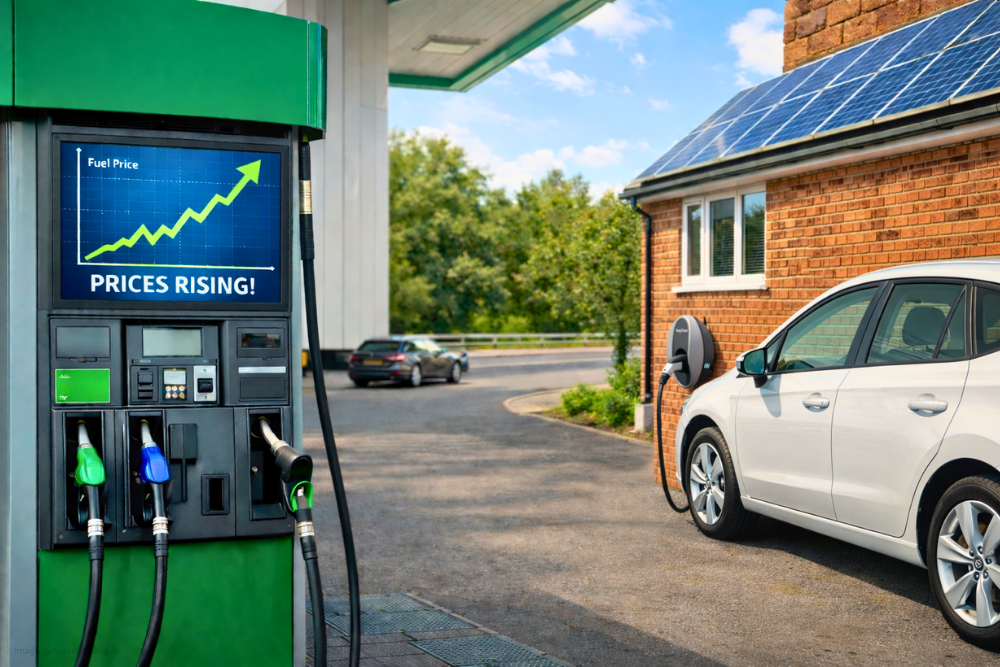
Across the UK, petrol and diesel prices have jumped sharply, driven by global instability and tighter oil supply. Price rises aren’t anything new, but the speed and scale of this one has a lot of people asking the same question: is now the time to move away from petrol and diesel and switch to electric?
We published an article at the end of March looking at rising fuel prices vs EV charging costs. Just three weeks later, we’re already revisiting it. Prices have hit a new high, pushing costs for petrol and diesel drivers up even further.
How much have fuel prices risen?
| Fuel Type | 21.03.2026 | 31.03.2026 | 20.04.2026 |
| Unleaded |
143.35p |
152.01p |
157.97p |
| Motorway Unleaded |
161.80p |
167.91p |
181.62p |
| Diesel |
163.73p |
181.20p |
190.94p |
| Motorway Diesel |
175.03p |
183.05p |
202.80p |
What does it really cost to charge an EV in 2026?
Even as electricity prices rise and petrol and diesel costs fall, traditional fuel prices would need to drop substantially before they could compete with the everyday affordability of EV charging. In many cases, EVs continue to benefit from significant savings on the cost of fuel. Charging a medium-sized electric car at home can cost less than half the price of filling up an equivalent petrol vehicle.
How to calculate pence per mile?
The easiest way to compare fuel costs is to look at the pence per mile of EVs and ICE vehicles. To work out how much charging / fueling your vehicle costs use the formulas below
| EVs | ICE Vehicles |
|
(Electricity rate in pence per kWh ÷ 100) x (Battery Capacity in kWh) ÷ Mileage |
(Price per litre ÷ 100) ÷ (MPG ÷ 0.22) |
How do costs really compare?
Lease Electric have compared three EVs to similar ICE alternatives, showing you how cost of charging VS refuelling with petrol or diesel compares this March
We have used the following prices:
| EV Charging | Petrol / Diesel - 31.03.2026 | Petrol / Diesel - 20.04.2026 |
|
Home Charger Tariff Good Energy EV Tarrif = 6.6p per kWh EDF Energy Go Electric with Pod Point = 8.49p per kWh |
UK Wide Unleaded Price = 152.01p per litre UK Wide Diesel = 181.20p per litre |
UK Wide Unleaded Price = 157.97p per litre UK Wide Diesel = 190.94p per litre |
| Average Public Charging Tariff Ultra Rapid Charger (150kWh +) = 82.52p per kWh |
UK-wide Unleaded Price - Motorway = 167.91p per litre UK Wide Diesel Motorway = 183.05p per litre |
UK-wide Unleaded Price - Motorway = 181.62p per litre UK Wide Diesel Motorway = 202.80p per litre
|
The figures have been sourced from RAC Fuel Watch and RAC Charge Watch. To find out more about our EV charging partner Pod Point, and the Home Charging Tarriff with EDF Energy, click here. For more information about Good Energy's EV Tarrif, Click Here.
Cost comparisons March 2026:
1. Volkswagen ID.3 and Vollkswagen Golf
We have compared the VW ID.3 with the VW Golf Hatchback, due to their similar dimensions.
|
Volkswagen ID.3 150kW Match Pro S 79kWh 5dr Auto [5 Seats] 350 miles (WLTP Combined) Battery Capacity =82kWh |
Volkswagen Golf Hatch Life 1.5 TSI 115ps 6-Speed Manual 5 Door 52.3mpg (WLTP Combined) |
|
|
31.03.2026 |
20.04.2026 |
|
|
Home Charging Good Energy = 1.5p per mile Home Charging EDF= 1.98p per mile |
Unleaded = 13.21p per mile | Unleaded = 13.72p per mile |
| Public Charging Ultra Rapid Charger (150kWh +) = 19p per mile | Motorway Unleaded= 14.6p per mile | Motorway Unleaded = 15.78p per mile |
2. MG S5 Long Range and MG ZS Exclusive
We have compared these vehicles, as the same model is available as either an electric vehicle (EV) or a petrol-fuelled vehicle.
|
MG S5 170kW SE EV Long Range 64kWh 5dr Auto 298 miles (WLTP Combined) Battery Capacity = 64kWh |
MG Z3 Exclusive 1.5 VTI-tech 5-speed Manual 47.0mpg (WLTP Combined) |
|
|
31.03.2026 |
20.04.2026 |
|
|
Home Charging Good Energy =1.4p per mile Home Charging EDF= 1.8p per mile |
Unleaded = 14.7p per mile | Unleaded = 15.27p per mile |
|
Public Charging Ultra Rapid Charger (150kWh +) = 17p per mile |
Motorway Unleaded= 16.24p per mile | Motorway Unleaded = 17.56p per mile |
3. Kia EV9 - Land Rover Ranger Rover Sport
Despite the difference in manufacturers, the comparison between the Kia EV9 and the Land Rover Range Rover Sport was made due to their similarity in size.
|
Kia EV9 282kW GT-Line S 99.8kWh AWD 5dr (7st) Auto 316 miles (WLTP Combined) Battery Capacity =99.8kWh |
Range Rover Sport S D250 39.4mpg (WLTP Combined) |
|
|
31.03.2026 |
20.04.2026 |
|
|
Home Charging Good Energy =2p per mile Home Charging EDF= 2.6p per mile |
Diesel = 20.91p per mile |
Diesel =22.02p per mile |
| Public Charging Ultra Rapid Charger (150kWh +) = 26p per mile | Motorway Diesel = 21.12p per mile | Motorway Diesel = 23.39p per mile |
How much does this cost over a year?
To help illustrate overall whole-life running costs, we’ve compared annual charging and fuel expenses based on a full year of driving. For simplicity, this example assumes a driver covering 10,000 miles per year.
For most EV drivers, the majority of charging takes place at home. However, occasional longer journeys,such as holidays,may require the use of public rapid chargers, typically found at motorway service stations. In this scenario, we’ve assumed 90% home charging (9,000 miles) and 10% public charging (1,000 miles).
The same annual mileage and assumptions are applied consistently across electric, petrol, and diesel vehicles to ensure a fair comparison.
1. Volkswagen ID.3 and Vollkswagen Polo
We have compared the VW ID.3 with the VW Golf Hatchback, due to their similar dimensions.
|
Volkswagen ID.3 150kW Match Pro S 79kWh 5dr Auto [5 Seats] 350 miles (WLTP Combined) Battery Capacity =82kWh |
Volkswagen Golf Hatch Life 1.5 TSI 115ps 6-Speed Manual 5 Door 52.3mpg (WLTP Combined) |
|
|
31.03.2026 |
20.04.2026 |
|
|
Home Charging Good Energy = £135 |
Unleaded = £1188.90 | Unleaded = £1234.80 |
|
Public Charging Ultra Rapid Charger (150kWh +) = £190 |
Motorway Unleaded= £146 | Motorway Unleaded= £157.80 |
|
10,000 miles = £325 |
10,000 miles = £1334.90 | 10,000 miles = £1392.6 |
2. MG S5 Long Range and MG ZS Exclusive
We have compared these vehicles, as the same model is available as either an electric vehicle (EV) or a petrol-fuelled vehicle.
|
MG S5 170kW SE EV Long Range 64kWh 5dr Auto 298 miles (WLTP Combined) Battery Capacity = 64kWh |
MG Z3 Exclusive 1.5 VTI-tech 5-speed Manual 47.0mpg (WLTP Combined) |
|
|
31.03.2026 |
20.04.2026 |
|
|
Home Charging Good Energy = £126 |
Unleaded = £1323 | Unleaded = 1374.30 |
|
Public Charging Ultra Rapid Charger (150kWh +) = £170 |
Motorway Unleaded= £211.20 | Motorway Unleaded =175.60 |
|
10,000 miles £296 |
10,000 miles = £1487.20 | 10,000 miles = 1549.90 |
3. Kia EV9 - Land Rover Ranger Rover Sport
Despite the difference in manufacturers, the comparison between the Kia EV9 and the Land Rover Range Rover Sport was made due to their similarity in size.
|
Kia EV9 282kW GT-Line S 99.8kWh AWD 5dr (7st) Auto 316 miles (WLTP Combined) Battery Capacity =99.8kWh |
Range Rover Sport S D250 39.4mpg (WLTP Combined) |
|
|
31.03.2026 |
20.04.2026 |
|
|
Home Charging Good Energy = £180 |
Diesel = £1881.90 |
Diesel = £2215.70 |
| Public Charging Ultra Rapid Charger (150kWh +) = £260 | Motorway Diesel = £192 | Motorway Diesel= £233.90 |
| 10,000 miles = £440 | 10,000 miles= £2093.10 | 10,000 miles = £2202 |
How do prices compare if I can not charge from home?
In the UK, access to off-street parking varies significantly depending on location. In some urban areas, up to 60% of households do not have access to off-street parking. While the national average sits at around 32%, this still represents millions of households unable to charge an EV at home.
If workplace charging isn’t available either, this leaves public charging as the primary option, often the most expensive way to charge an electric vehicle. But how does the cost really compare?
In reality, EV drivers without access to home or workplace charging tend to be savvy. They don’t rely solely on rapid chargers at premium prices, instead using a mix of charging options to keep costs as low as possible.
As an example, we’ve used the Volkswagen ID.3 featured throughout this article to illustrate how a mixed charging strategy could affect annual charging costs for a driver covering 10,000 miles per year.
Our calculations assume a blend of public charging methods, with 60% charged via 7kW public chargers, such as the Pod Points commonly found at Tesco and Lidl, alongside 20% rapid charging and 20% ultra-rapid charging.
|
Volkswagen ID.3 150kW Match Pro S 79kWh 5dr Auto [5 Seats] 350 miles (WLTP Combined) Battery Capacity =82kWh |
|
|
Pod Point - Tesco 7kWh = £0.44 per kWh =10.3p per mile |
6,000 miles = £618 |
|
InstaVolt Rapid Charger - 50kW = £0.89 per kWh = 20p per mile |
2,000 miles = £400 |
|
GRIDSERVE Electric Higway - 180kW = £0.89 per kWh = 20p per mile |
2,000 miles = £400 |
|
10,000 Miles Per Year |
£1418 |
If this driver relied solely on rapid chargers, such as those on the GRIDSERVE Electric Highway, the cost to cover 10,000 miles would be around £2,000 per year.
How do rising fuel prices impact individuals?
For individuals, rising fuel prices are being felt immediately. Weekly fuel spend has increased, and costs have become harder to predict. EVs offer a clear alternative, lower running costs, particularly when charging at home. For drivers covering regular mileage, the financial case is now stronger than ever.
How do rising fuel prices impact businesses?
For businesses, the impact is more strategic. Rising fuel costs directly affect fleet expenses, delivery pricing, and overall operational efficiency. This makes transitioning to electric not just an environmental decision, but a commercial one. EVs can significantly reduce running costs, improve cost predictability, and protect businesses from ongoing fuel volatility. When combined with tax efficiencies and salary sacrifice schemes, switching to electric is quickly becoming a competitive advantage, helping businesses reduce costs while positioning themselves for the future.
If you're considering switching to an EV, and would like to know more about charging, we have a few EV guides that you might find useful: